Wednesday, September 8, 2010

Our Socialist Founding Fathers?

After a summer of reading fiction, I decided to return to my roots and read some good academic history. While in Amhearst last month, I picked up an item in a used textbook store called “The Economy of Colonial America”. It revealed some interesting information, based on economic historical research, which is all the more interesting in light of current political discourse.

One of the significant economic issues in the colonies was the lack of money. The colonial economy was overwhelmingly agricultural and raw materials were the basis of its exports. Notably, however, most economic activity was among the colonies, not goods for export. The exported products were mainly tobacco, wheat, corn, fish, animal skins, lumber products and the like. These products were sold to England, to southern Europe and to the plantations in the Caribbean. By law, some products - like tobacco and ship masts - could only be sold to English firms. Also by law, hard currency in the form of gold and silver coin could not be sent from England to the colonies nor could the colonies establish a mint. Hard currency, which was the primary currency of the day, was gathered mostly in the form of Spanish coins earned through sales in southern Europe and the Caribbean. But this international trade was a relatively small portion of the overall economy. Of note, some of the currency to reach our shores was courtesy of pirates who came to the east coast to spend freely after unburdening a Spanish ship of it’s chests of gold and silver!

Colonial governments did a number of things that were very innovative at the time in order to address the money issue and promote their economy. First, some colonies created “commodity currency” wherein the government set up a warehouse for farmers to deposit non-perishable products such as tobacco or beaver skins. Farmers were issued bills denominated in that commodity such as a bill worth one hogshead of tobacco. The farmer used this currency to buy other goods and the eventual holder of the bill took it to the warehouse for credit against imported English goods when the harvest was sold. One problem with this method, however, was that the ultimate value of the bill was dependent upon the “price” that the harvest eventually yielded.

Another government program in many colonies was the establishment of a land loan program. There were no banks in the colonies and most credit was provided by English merchants extending credit to exporting farmers. To help facilitate the purchase of land, the colonial governments set up programs to loan money for the purchase of land and held those mortgages. Typically, the government would lend up to 50% of the land value and collect a modest interest on the loan. This was a important method for providing credit to the largest segment of the economy. It also made the colonial governments large stakeholders in the largest portion of the economy by holding the mortgages (and taking possession of the land if it defaulted).

Finally, colonial governments issued their own currency, starting in 1690. This currency is unlike currency today, however. Since colonial governments were very small and money was tight, they turned to issuing paper money when confronted with a large expense. Large expenses occurred when colonial soldiers were mustered for one of the frequent border hostilities with the French or Indians. They were also incurred when colonial governments decided to issue currency as a way to promote more economic activity during economic slumps. For example, after successful economic stimulus issuances in Pennsylvania and New York, Maryland did a currency issuance in 1733 where it gave 30 shillings to every taxable individual. Amounts due for taxable indentured servants and slaves were given to their masters. Thirty shillings, at that time, was about 15% of the average annual income of a colonist.

These currencies were redeemable usually after two or three years as payment against public debts – meaning the payment of taxes, fees or loan repayments for land. Once turned in to the government, the currency was destroyed. Some colonial governments tried to make the currency legal for private debts as well. This met with resistance from English merchants who were the primary lenders to colonists. These merchants did not want a colonial court to order them to accept colonial currency to settle their debts. Parliament twice passed laws, in 1751 and 1764 to prohibit or limit the widespread use of colonial currencies but colonies persisted in doing so, with many colonies rolling one expired issuance into another in a stream of regular governmental debt in the form of paper money.

The overall effect of colonial governmental actions, combined with a myriad of other factors such as cheap land, shortages of labor and abundant natural resources, is that the colonial economy grew steadily throughout the pre-Revolutionary period. In fact, the average colonist on the eve of the Revolution was healthier than an Englishman, taller by about two inches (owing to better nutrition) and wealthier (since wealth was generally gathered through land ownership).

But how would these policies be viewed in today’s political atmosphere? One could argue that they are the sensible actions of a government dedicated to improving the life of its citizens by using government resources to support economic growth. Conversely, one might argue that government ownership of the major industry – agriculture (through land mortgages and, sometimes, foreclosures), it’s regulation of the main method of exportation (through commodity currency warehouses), it’s redistribution of wealth (through currency issuances) to stimulate the economy and it’s unending addiction to government debt (also through currency issuance) add up to just one thing. Socialism! Long before there was a Karl Marx, America was founded on socialism. I am ashamed.

Friday, August 27, 2010

Second Holiday Scan Results


I had my second scan last week (since going on chemo break) and met with Dr. S a few days ago to get the results. As expected, I had some more growth but not an outrageous amount. The larger lesions are a little bigger than a nickel. That’s slightly larger than when I started way back when. At their minimum, about 9 months ago, they were about the size of a dime. So the end result is that I have been given another two months off!

I had some time to discuss future treatment with the doctor and I am quite encouraged. He indicated that I will probably go back on treatment after my next scan but it’s possible that I could hold out until after Thanksgiving. And, although he never makes predictions about future treatments, he did imply that we might get into a pattern where I would be in treatment for six months or so and then get another break for a few months and then back in treatment again, etc. This is exceptionally good news as I am coming to realize that, perhaps, we are turning this thing into a slow moving, chronic condition. While that certainly has a downside, it is a huge positive in my mind and, frankly, changes my perspective quite a bit.

I have been concerned since the start that I was on shaky ground and that, without treatment (or even with treatment), my condition would rapidly deteriorate. And the statistics on my prognosis bear that out – at diagnosis, the averages for guys like me were: an average lifespan of 21 months and a 5 year survival rate of 8%. But as I see it now, after 22 months, I am barely worse off than when I started. My goal had been to reach 21 months and I have done that without giving much ground at all. I think the chances are good that I can continue in a cycle of treatment and rest periods for several years. And this realization has broadened my view a lot. I no longer feel that gnawing anxiety of wondering if I’m about to step off a cliff. It’ll be a grind during treatment but I will have the break periods to look forward to. I can also think more long term and feel more confident that I will be here for the kids in something like a useful way. This makes me incredibly happy and hopeful! My new goal is to be an 8%er!

So HOORAY and THANK YOU all for your tremendous support!!

Of course, this means that you will have to put up with my blogging for the foreseeable future…

Sunday, August 22, 2010

"The Big C" on Showtime


In case you haven't heard, Showtime has started a new series called "The Big C" starring Laura Linney. The plot of the show is that a woman is diagnosed with Stage IV melanoma at the age of 42. She doesn't tell anyone, not even her family, but she begins to act differently. She had a reputation as a careful, rather "boring" person and is now doing bold and spontaneous things. It's pitched as a comedy but I guess it's more of a "dramady". Laura Linney is excellent as the lead character, so I will keep watching. But I am interested in seeing where they take this.
I like the idea that television is taking on a tough issue like advanced cancer and further that they are doing it through comedy. We have to be able to keep laughing, and laugh at ourselves, especially when things seem bleak. I'm a little concerned, though, that a) she decides not to tell her friends and family and b) she refuses treatment.
By talking about cancer honestly, we help to de-mystify it and make it easier for everyone to deal with it. In some ways, I think cancer is scarier to those who don't have it than those who do. Also, by talking about it as something that we deal with, like so many other difficult things people deal with, we can keep our sense of who we are. Being a "cancer patient" is a bit de-humanizing. Being a person who has cancer isn't. Also, a cancer diagnosis is tough emotionally and affects your spouse, your children, etc. You need the support of those around you and you need to help your loved ones understand what's going on so that they can cope with their own feelings about the things that will be changing for them, as well as for you.
And finally, I'm concerned about the character's refusal to be treated. Her reasoning seems to be that she has been given a certain amount of time to live and wants to live it without the effects of treatment, most notably the loss of her hair. I hope the show addresses the fact that no doctor can tell you how long you will live. They can only give you a statistic for how long, on average, people with your disgnosis lived. There is a broad band of actual outcomes. For example, all the oncologists I spoke with when I was diagnosed gave me the same figure for how long I would live (on average) - 21 months. This was my life expectancy with treatment. That was 22 months ago and I've still got a long way to go. So you can never let yourself succumb to the statistics, you need to fight your own battle.
I hope these things emerge - along with some good humor - over the coming weeks of the series. And, I hope you give the show a look. The first episode (last week) was pretty good.
By the way, I don't have Showtime - it's available for viewing on Showtime.com and other on-line sources.
Hope you are having a fun finish to the summer! BB

Monday, August 9, 2010

11 Percent Unemployment?


I'm going to make an economic prediction - hey why not, everybody else does!
The Bureau of Labor Statistics July report puts the unemployment rate at 9.5% after a July net loss of 131,000 non-farm jobs. The private sector is credited with creating 71,000 jobs while government (at all levels) shed 59,000 jobs. The total government loss was 202,000 but 143,000 of them were temporary census workers. So the structural drop in government employment is 59,000 jobs.


The drop in government jobs reflects the budget cutting going on mostly at the state and local level to balance budgets. In New Jersey, we have seen it at the state level as this year was the first year I ever recall the state balancing the budget. At the local level, it seems that every town in the state is cutting payrolls to balance their budgets. This, by the way, has led to almost daily reports in the papers about what jobs were eliminated in what towns. In Morris Township, our budget was balanced in part by eliminating 16 positions and furloughing various groups of employees (essentially cutting their number of paid days in the year). The cuts hit all departments, including fire services, road maintenace, etc.

For fans of smaller government, this means that the economic crisis is a dream come true. State and local governments are getting smaller and services are being eliminated. It's just a matter of time before the same occurs at the Federal level. Also, since most (perhaps all) economists are predicting a long slow recovery in terms of job creation, I would expect unemployment to stay high as any growth in the private sector is likely to be matched or exceeded with declines in the public sector.

One thing that is unclear to me is the effect of the "Stimulus" of 2009 on the unemployment rate. The Congressional Budget Office has a wide range in it's calculation of how many jobs have been saved. But, I think that it's safe to say that the jobs being saved are in the private sector. After all, when they put stimulus dollars into fixing a road or funding a new industry, it is private sector contractors that get the government contracts to do the work. The range of CBO estimates is currently a low of 1.4 million jobs and a high of 3.4 million jobs. So how has that affected the unemployment rate?

The 9.5% unemployment rate is based on a count of 14.6 million people seeking jobs. Without the stimulus, this number would range from a low of 16 million to a high of 18 million, depending on which calculation of jobs saved is correct. Let's split the difference and say 17 million. If there had been no stimulus, then, the unemployment rate would be approximately 11%. Since all of the stimulus "projects" I have seen are of limited duration - once the road is built, the job goes away - it's effect on employment will diminish over time. Therefore, I would predict that unemployment will rise toward the 11% mark unless the private economy can get more steam without this government support.

Isn't that a cheery thought! BB


Wednesday, August 4, 2010

Stieg Larsson is an Addiction

I'm not much of a fiction reader but I thought I'd write a quick review and warn you all to stay away from Stieg Larsson. The last of the "Dragon Tattoo" series came out recently, but naturally, I hadn't read the first two so I paid no attention. However, my voracious novel-reading daughter insisted that I read "Girl with the Dragon Tattoo". I put it off as long as possible, but while flying back from France, I was stuck with an 8 hour block of time so I started it. By the time the plane landed, I was hooked. I read that book straight through and then went immediately to the second book "Girl who Played with Fire" and read that like a man possessed. Finally, I begged a copy of "Girl Who Kicked the Hornet's Nest" from a friend and just finished it. The main characters in the book are, each in their own way, obsessive and if you read these books, you too will become obsessed - obsessed with reading more. The novels are at times creepy and disgusting but always intriguing - a bit of "Silence of the Lambs" here, a little "Bourne Identity" there. And, in some cases, there are so many characters, you'll be tempted to take notes!

But - if you decide to read them, be warned: you will stop bathing and shaving, you will leave the dishes in the sink and eat only sparingly, your family will become just background noise and the mail will remain unopened in the box. You will simply sit there reading into the wee hours until you've read every word! In short, Stieg Larsson is an addiction.

But I have my life back now...

Thursday, July 29, 2010

Paris


After our week in London, we took the train through the "chunnel" to Paris. It's a very easy ride and only takes about 3 hours. Along the way, you see some very nice French countyside.
We had (again) a very nice hotel in Paris and in a very nice (upscale) neighborhood, about 5 blocks north of the Louvre. Paris is very beautiful and very walkable. In fact, it's so beautiful that my favorite thing to do was often just to wander around. We took in the major sites and quite a few lesser ones as well. I could have stayed another week. Also, I kicked the rust off my college french and enjoyed speaking with anyone willing to speak a little more slowly than usual so that I could understand them. There were, however, plenty of people who spoke english so I don't think there was much of a language barrier.
Parisien life is decidedly later than London life. In London, the pubs are hopping every day from about 5 pm to 8 pm. The crowds always spilled out onto the sidewalk, where you are allowed to bring your drink. Anytime you saw a crowd on the street at that time, you knew you were passing a pub. In Paris, I didn't see much of a happy hour crew. But, from about 9 pm to 11 pm, the cafes were full. As they do during the rest of the day, people re-arrange the sidewalk chairs to all face the street so they can chat while watching the world go by. We enjoyed doing the same.
Paris also has incredibly good bread and chocolate! The boulangerie (bakery) near our hotel sold fresh baguettes every morning for 0.88 euros (about $1.25). I did notice, however, that in less trendy neighborhoods, a baguette was closer to 0.80 euros. We could make up sandwiches for the 4 of us with one baguette. So, we bought sandwich fixings and made ourselves lunches to eat in the park as we toured around. Eating in the park was fun as you get to soak in more of everyday goings-on (like the sand castle building contest we saw a kindergarten-age class do in the park directly adjacent to Notre Dame!)
We were in Paris over the Bastille Day holiday (their 4th of July) and caught the fireworks at the Eiffel Tower. We walked back to the hotel, down the Champs Elysee after midnite, and the place was hopping! It was a long walk, as traffic was snarled and no cabs were to be found anyway, but it was so pretty that no one cared.
So, although we had to leave a few museums and a few neighborhoods unexplored, we enjoyed the visit quite a bit. And, I am told, we missed quite a heat wave while we were away!

London

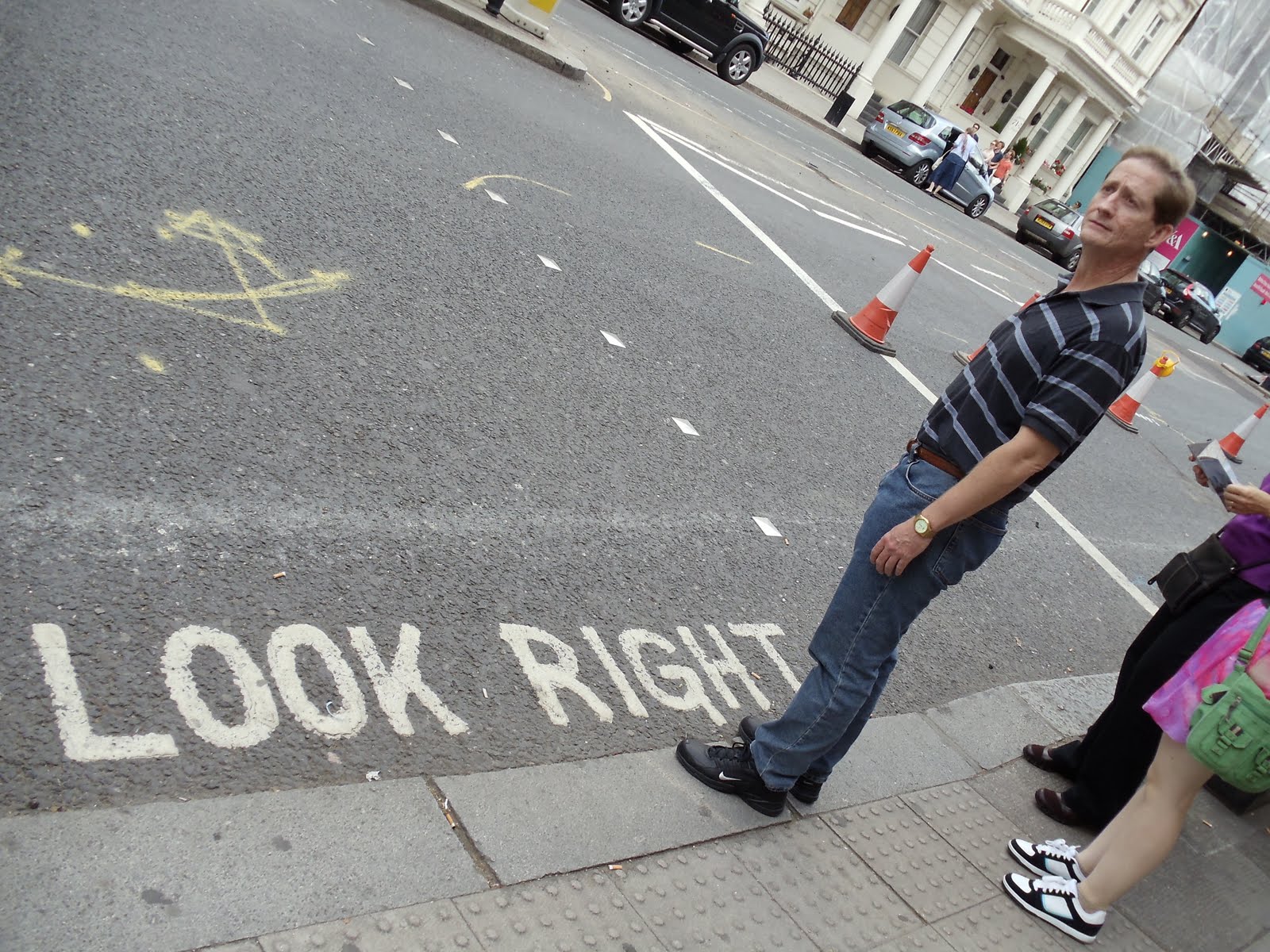
No, this picture is neither a political statement nor a comment on my ability to follow directions! Last week we returned from a trip to Europe with the kids. We started with a week in London (and a side trip to Birmingham) and then went to Paris for a week. The weather was great and we got a chance to see a lot of the sites.
London was a lot of fun for the family. We have friends there who have kids around our kids' ages so they got to hang out. It also turned out that a friend of ours was there for the week (for work) in the same hotel - so we spent some time with her, too. I've been to London a number of times before so I was happy to be able to share some of the things I like about the city with the kids. The only down note of the week in London was that I picked up some kind of virus and ran a high fever. As a result, I spent the last three days there at the hotel, sleeping a lot.
But I did meet a very nice doctor who was a referral from the hotel front desk. He is in private practice in the neighborhood where we stayed (South Kensington). He also had the most elegant doctor's office I've ever been in - in a classic South Ken browstone. We got a chance to talk a little bit about medical care in the US and the States. Also, as a point of comparison, my office visit with him cost L105 which, at current exchange rates is about $170. That's probably pretty comparable to the states for a doctor visit in a large city I would think.
Since I couldn't really go out sight-seeing, I would just take a walk in the neighborhood or sit in the park (Kensington Park) and read the paper until I felt fatigued again and went back to the hotel. These lttle walks were rather interesting though, because I got to see some of the "regular" London life, albeit in an upscale part of town. One day I watched the procession of girls from a school in their uniforms (lavendar floral dresses, knee socks and matching jackets) go in groups to the church across the street for what appeared to be the end-of-year ceremonies. Each group would go in for about 15 minutes and upon return some would be carrying trophies of various sizes. In one case, a couple of girls came out crying (and trophy-less) and I wonder whether they had their heart set on some award which they did not win.
I also overheard a funny item between some American tourists. While sitting in Kensington Park near the Albert memorial, an American couple strolled by. The Albert Memorial is huge, with scenes from far off lands, like Indian elephants, African scenes and American bison, carved at the four corners of it's base. The woman stopped to take a picture when the man said "You already got that one." She replied "I did?" "Yes", he said "You know, it's the memorial to what-his-name...see, there's that college of... whatever in the background. You know the one they stopped working on back in...whenever." "Oh, yeah" she said. And she put her camera away. Now that's communicating!